
Published by PlentyField, a product of Zefiro Renewables LLC. Web article updated . An introduction to the physical arrangement; each project needs its own technical design.
What is a containerized data center?
A containerized data center houses computing equipment and its supporting systems in a purpose-built enclosure. It brings together the space for servers, network connections, electrical distribution and cooling. The enclosure is one part of an installation: a usable electrical supply, fiber service, outdoor equipment and safe access must also be provided at the property.
“Containerized” describes the physical form. “Modular” describes an approach in which capacity can be developed in repeatable units. A module can be an initial installation or one of several at the same site. Modules still need coordinated electrical, cooling and network designs; adding another container does not by itself create usable computing capacity.
For the development and commercial approach behind these installations, see how PlentyField develops containerized data centers. This article focuses on what the equipment does and how it fits together.
What sits inside the unit?
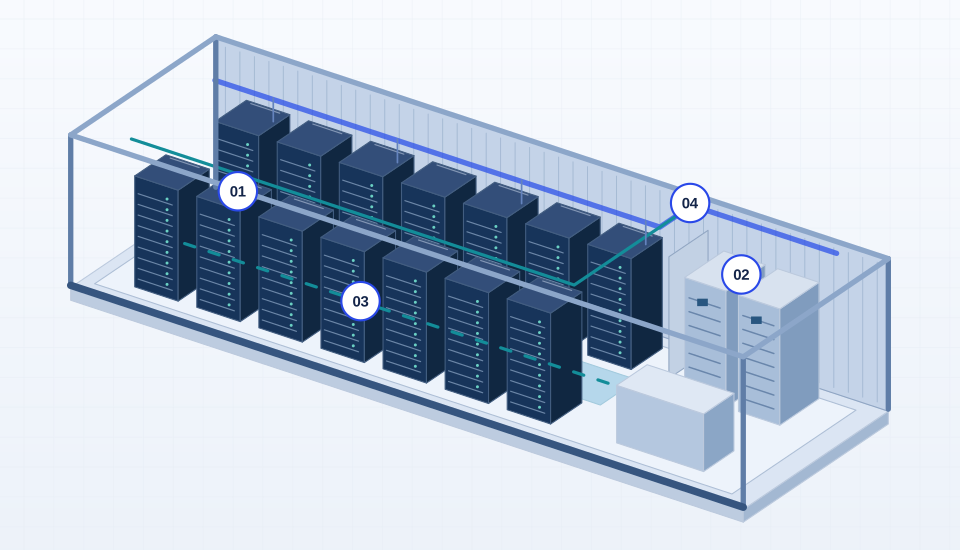
- Computing equipment
- Servers carry out the customer’s processing tasks. Processor capability, memory, storage and the way equipment communicates must suit the workload. AI inference, rendering and simulation can have different requirements, so the hardware is specified through technical review.
- Networking
- Network equipment connects the servers to one another and to the service delivered at the site. Internal connectivity and the external fiber connection serve different purposes. Workloads requiring close coordination between servers need to fit the proposed network design.
- Power distribution
- Incoming power is distributed to the computing and supporting equipment through the appropriate protection and controls. Continuity arrangements, including any uninterruptible power supply and batteries, are specified for the project and service expectations. No particular resilience level follows simply from using a container.
- Cooling
- The cooling system removes heat from the equipment and transfers it outside. PlentyField’s approach uses a closed cooling circuit with heat rejected to outside air. Outdoor cooling equipment, airflow, local climate and sound all affect the arrangement. The final design must be matched to the selected computing equipment.
- Maintenance access
- Aisles, doors and equipment clearances allow inspection, servicing and replacement. The layout must also accommodate safe entry and exit. Filling every available space with racks would leave out an essential part of operating the installation.
The container footprint is not the installation area
The footprint is the area directly beneath the enclosure. The overall site area must also fit electrical equipment, cooling, connection routes, clearances and delivery and maintenance access. An available patch of ground that fits a container may still be unsuitable once these requirements are considered.
Overall installation area
- Container footprintComputing equipment and internal systems
- Supporting equipmentElectrical connections and outdoor cooling
- Access and clearancesDeliveries, servicing and safe movement
- Potential expansionSpace to assess for another module
No single site-area figure suits every capacity or location. A site plan or marked photograph is useful for a first review. PlentyField develops the arrangement around the proposed equipment, property constraints and applicable requirements.
What is needed at the property?
Usable power: the utility and owner need to confirm the capacity available for the new load, the service arrangement and any connection work. A transformer rating alone is not proof of spare capacity. Facility power includes cooling and other supporting systems as well as the computing load.
Deliverable fiber: a provider needs to confirm the service it can supply at the property, including connection work and timing. A nearby route on a map is a lead to investigate, not confirmation that the proposed service is available.
A workable location: delivery routes, site permissions, access, noise and compatibility with the existing business need assessment. Our guide to power, fiber and site readiness explains what information helps establish these conditions.
How can additional modules expand a site?
A site can be developed in phases when the initial installation and future works are planned together. The assessment considers additional electrical capacity, network connections, cooling, access and the effect of construction on existing operations. Later modules depend on agreed customer requirements and the technical and commercial conditions for expansion.
More modules at one property and separate sites in different regions are not the same as a single computing cluster. Workloads that need tightly connected equipment must be assessed against the resources and connectivity at the proposed location.
What does a PlentyField customer buy?
Customers buy access to computing capacity for their applications or services. PlentyField invests in, builds and operates the physical infrastructure. The proposal defines the computing resources, connectivity, access, software and support responsibilities, commercial terms and acceptance conditions.
We are developing future capacity. The site, equipment and delivery dates are confirmed through the project process. Read how our computing-capacity service works for the requirements we assess and the steps from enquiry to agreement.